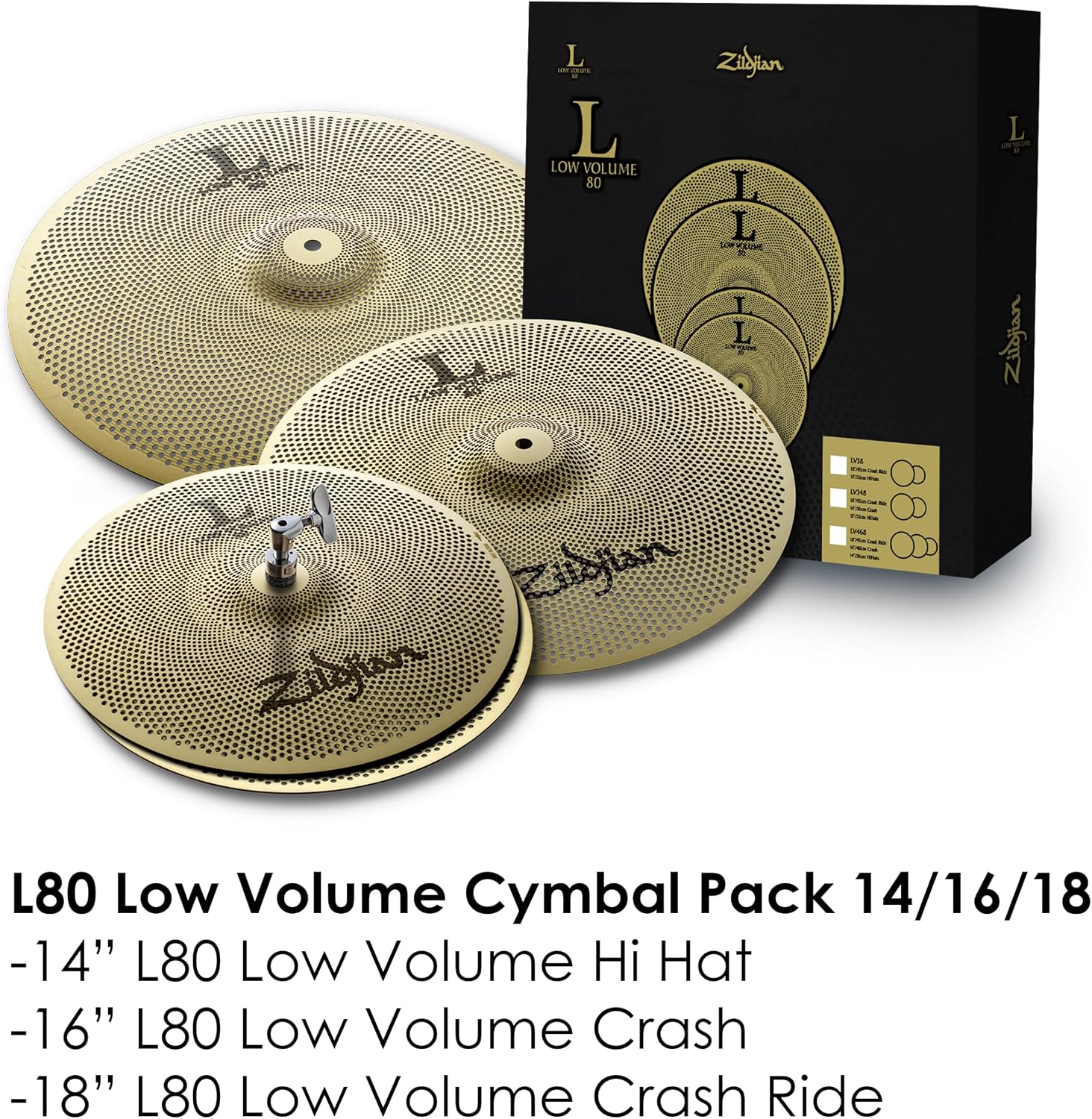
If you’ve ever wanted to play your acoustic drum kit in an apartment, a townhouse with paper-thin walls, or a home studio at 10 PM without triggering a noise complaint — low-volume cymbals are the piece of the puzzle most drummers discover a year or two too late. The concept is simple: a low-volume cymbal is a standard-shaped cymbal (hi-hat, ride, crash) made from a perforated or mesh-like material that reduces its acoustic output by roughly 70–80% compared to a traditional brass cymbal, while still responding to your sticks in a way that feels close to the real thing. You play them exactly like regular cymbals; they just don’t shatter the silence. This guide breaks down how they work, which packs represent real value, what the tradeoffs look like at every price point, and how to decide whether they belong in your setup.
How Low-Volume Cymbals Actually Work — And What They Can’t Do
The physics here are worth understanding because they explain both the strengths and the limitations of every product in this category.
Traditional cymbals are solid bronze or brass alloy discs. When struck, the entire surface vibrates and radiates sound in all directions — that’s what produces the loud, cutting wash that carries across a rehearsal room. Low-volume cymbals interrupt that vibration pattern in one of two ways: perforation (hundreds of small holes punched through the cymbal surface that break up the vibrating mass) or layered mesh construction (a woven surface that absorbs rather than radiates energy). Zildjian’s L80 series uses the perforated approach. Sabian’s Quiet Tone (QT) and Evans’ dB One use variations on perforated steel or alloy. The result, per published manufacturer specs and confirmed across aggregated owner reviews, is a volume reduction to roughly 80 dB peak at typical playing intensity — compared to 110–120 dB for a standard crash.
What they don’t replicate perfectly is sustain and wash. The open, shimmering decay you get from a Zildjian K or a Meinl Byzance is physically dependent on an uninterrupted vibrating surface. Perforated cymbals have a drier, shorter decay. Owners consistently describe the feel as “about 85% there” — good enough for serious technique work, chop development, and sight-reading practice, but not a substitute for a real cymbal when you’re listening critically to tone.
The other honest caveat: low-volume cymbals reduce airborne sound (the crash you hear across the room), but they do very little about impact transmission through the floor and walls. A bass drum pedal on a hardwood floor still sends vibration through the building structure. If neighbor complaints are your actual problem, low-volume cymbals are one piece of the solution — isolation platforms and mesh bass drum heads are the complementary moves.
The Main Players: What Each Pack Offers and at What Cost
By the numbers — typical pack configurations and street prices (May 2026):
| Pack | Configuration | Approx. Street Price |
|---|---|---|
| Zildjian L80 Low Volume Box Set (LV468) | 14” hi-hat, 16” crash, 18” crash/ride | $220–$260 |
| Sabian Quiet Tone Practice Cymbal Set | 14” hi-hat, 16” crash, 20” ride | $180–$210 |
| Evans dB One Low Volume Cymbal Set | 14” hi-hat, 16” crash, 20” ride | $170–$200 |
| Meinl Classics Custom Quiet Set | 14” hi-hat, 16” crash, 20” ride | $230–$270 |
The Zildjian L80 is the category reference point and, based on patterns across aggregated reviews at MusicRadar and Sweetwater’s buying guide, the set most drummers end up recommending when someone asks in a forum what to buy first. The alloy is proprietary, the perforations are precisely sized, and the hi-hats in particular earn consistent praise for foot-pedal response — which matters more than people expect, because hi-hat chick feel is one of the first things to feel “off” on cheaper alternatives.
The Sabian QT set is the honest budget alternative. Sabian’s published product documentation describes the steel construction and the volume reduction as equivalent to L80 on spec, and owners who’ve used both tend to confirm the loudness numbers hold up. Where QT loses ground, per MusicRadar’s category coverage, is in longevity — the steel surface shows wear and corrosion faster than Zildjian’s alloy under regular use, and the hi-hat response is described as marginally stiffer.
The Evans dB One enters at roughly the same price as QT but approaches the engineering differently: Evans uses a layered construction closer to their drum head heritage, which gives the cymbals a slightly different feel under the stick — a touch more “thud” than “chick.” Drumhead Magazine’s apartment drumming feature noted that players who come from an electronic kit background sometimes prefer this response because it’s closer to what they’re used to on mesh pads.
The Meinl Classics Custom Quiet set is the premium outlier. It’s priced above the Zildjian pack and justified primarily by the Meinl brand’s reputation for cymbal feel — owners consistently report that the hi-hats feel the most natural of any low-volume option, and the ride bow has a better stick definition than any of the competitors. If you’re working on jazz comping or anything where ride articulation actually matters to your practice, this is the set that reviewers at Sound On Sound consistently point toward.
The Hidden Costs Most Buyers Miss
Low-volume cymbal packs look like a clean, contained purchase. They mostly are — but a few costs catch buyers off-guard.
Cymbal stands. If you’re replacing your existing cymbals for practice use, you probably have stands. If you’re building a dedicated practice kit, stands are a real line item. Budget-grade stands from Pearl or Gibraltar start around $40–60 each; a three-piece setup adds $120–180 before you touch the packs themselves.
Bass drum and snare volume. This gets overlooked constantly. You buy the low-volume cymbal pack, set it up, start playing — and realize the snare is still cracking at full volume. Low-volume cymbals are most effective as part of a complete quiet practice setup. Evans and Remo both make low-volume snare and tom heads (the Evans dB One head series, Remo’s Silentstroke mesh heads) that pair logically with the cymbal packs. Budget another $60–120 to address the drum heads if you haven’t already.
Dedicated stands versus conversion. Some players prefer to keep two full setups: their regular cymbals for when the room and time allow, and a dedicated low-volume setup for practice sessions. That means a second set of stands — or accepting that cymbal swaps take 20 minutes and break your practice momentum. The drummers who actually maintain a consistent practice habit, per community forum consensus documented in Sweetwater’s buying guide anecdotes, tend to have the two setups coexist on separate stands rather than swapping.
Resale. Low-volume cymbals hold value reasonably well because demand is consistently high and the category doesn’t change rapidly. Zildjian L80 sets typically sell used for 60–70% of retail after a year of moderate use, which compares favorably to budget acoustic cymbals that often drop to 40–50%. This matters if your living situation changes and you no longer need the quiet setup — you’re not throwing money away.
Integrating Low-Volume Cymbals Into Your Existing Setup
The practical question for most intermediate players isn’t “should I buy these” — it’s “how do I fit this into what I already have and how I already practice.”
A few decision frames worth naming explicitly:
If you play acoustic but have noise restrictions only some of the time (e.g., late evenings, weekends during certain hours), the cleanest solution is a parallel stand setup where you can switch between your regular cymbals and the low-volume set in a few minutes. It’s more upfront cost but preserves both workflows.
If you’re primarily an electronic kit player who also owns an acoustic kit, low-volume cymbals on the acoustic kit close the gap between the two practice contexts. The feel difference between mesh drum pads and low-volume cymbals is smaller than the feel difference between mesh pads and full-volume brass. Players making this move report that their acoustic chops transfer more reliably when the volume constraints are removed as a psychological obstacle.
If you’re building a home studio and tracking acoustic drums is part of the goal, low-volume cymbals are practice tools only — they won’t translate to a tracked sound worth keeping. Be clear with yourself that this is an investment in your practice infrastructure, not your recording workflow.
If you’re a touring musician using hotel rooms and backstage spaces for maintenance practice, the portability math favors the Zildjian L80 or Sabian QT packs specifically because they’re light enough to travel. Some players pack a folding snare stand, a practice pad, and two or three low-volume cymbals as a travel kit. The Evans dB One set is slightly heavier due to the layered construction.
The Decision Rule
Low-volume cymbal packs are one of the highest-utility, lowest-regret purchases in the intermediate drummer’s toolkit — with one clear condition: they solve a specific problem (acoustic volume in a noise-constrained environment), and if that’s not your problem, they’re an unnecessary purchase.
If you practice acoustic drums in a space where volume is a genuine constraint — apartment living, shared walls, family schedules, late-night sessions — buy the Zildjian L80 LV468 set as the default choice. The Meinl Classics Custom Quiet is worth the premium specifically if hi-hat and ride feel are critical to the technique you’re building (jazz, funk, nuanced comping work). The Sabian QT and Evans dB One are credible budget alternatives that sacrifice some longevity and feel refinement for a $40–60 savings.
If your noise problem extends to the kit itself (bass drum thump, snare crack), pair the cymbal pack with Remo Silentstroke or Evans dB One drum heads on your snare and toms. The cymbal pack alone won’t solve a whole-kit volume problem — but as part of a complete quiet practice system, it’s the piece that makes the whole thing feel like playing drums instead of playing a practice simulation.
The drummers who stay sharp between gigs and recording sessions aren’t always the ones with the best gear. They’re the ones who removed the friction from consistent practice. For anyone playing under a noise ceiling, low-volume cymbals are one of the most direct ways to remove that friction — and at $180–270 for a complete set, it’s one of the better investments per practice hour you’ll find in this price range.