A practice pad is exactly what it sounds like: a compact, quiet surface you hit with drumsticks to build the muscle memory, finger control, and stick technique that real drumming demands — without waking up the neighbors or hauling out a full kit. Think of it as the drummer’s equivalent of a pitcher’s bullpen. If you’re an intermediate player, you already know the basic concept. What you might not know yet is that the pad sitting on your desk is probably holding you back. The surface tension (how much the pad “pushes back” against the stick), the rebound feel (how quickly the stick bounces off), and the material all change how your muscles learn — and practicing on the wrong pad is a bit like training for a marathon in flip-flops. This guide breaks down what experienced players actually rely on, what the real tradeoffs look like across the $30–$300 range, and gives you a clear decision framework for your next purchase.
| EDITOR'S PICK[Zildjian Reflexx Conditioning P](https://www.amazon.com/dp/B09GXG773H?tag=greenflower20-20)… | Mid-tierVic Firth 12" Double sided Prac… | Budget pickRemo RT-0010-00 10" Gray Tunabl… | |
|---|---|---|---|
| Size | 10" | 12" | 10" |
| Surface type | Conditioning | Double sided | Tunable |
| Material | — | — | Coated drumhead |
| Price | $84.95 | $54.95 | $32.95 |
| See on Amazon → | See on Amazon → | See on Amazon → |
Why Your Practice Pad’s Feel Matters More Than You Think
Here’s the thing most beginner-facing reviews skip entirely: surface tension isn’t just a comfort preference — it’s a training variable. A pad with high rebound (very bouncy, very responsive) like a standard gum-rubber surface teaches your fingers to stay relaxed and exploit stick rebound. That’s great for rudiment speed work. But overly bouncy surfaces can actually mask underlying technique problems; if the pad is doing half the work, your hands aren’t learning to.
Low-rebound surfaces — certain foam compounds, mesh heads, or the more aggressive “coated” gum blends — force your hands to control every stroke consciously. Owners consistently report that switching from a high-rebound gum pad to a mesh pad initially slowed them down, only to break through to better control afterward. That’s the training effect, not a flaw in the gear.
Sound On Sound’s drum practice pad roundup (archived 2024) makes the useful distinction between maintenance pads (for warming up and staying sharp) and development pads (for building new technique). Maintenance pads can be forgiving. Development pads should challenge you.
Where you’re practicing also matters. An apartment player at midnight has different constraints than someone in a studio. The pad needs to solve an acoustic problem and a technique problem simultaneously — and for most intermediate players, those two problems don’t have the same answer.
The Real Options: A Breakdown by Surface Type and Price
Gum Rubber Pads: The Workhorse Standard
The vast majority of practice pads on the market use a gum rubber playing surface — a dense, slightly grippy compound that gives a medium-to-high rebound. The Remo Practice Pad (12-inch, the one with the coated drumhead surface on top) and the Evans RealFeel series are the two names that come up constantly in this conversation.
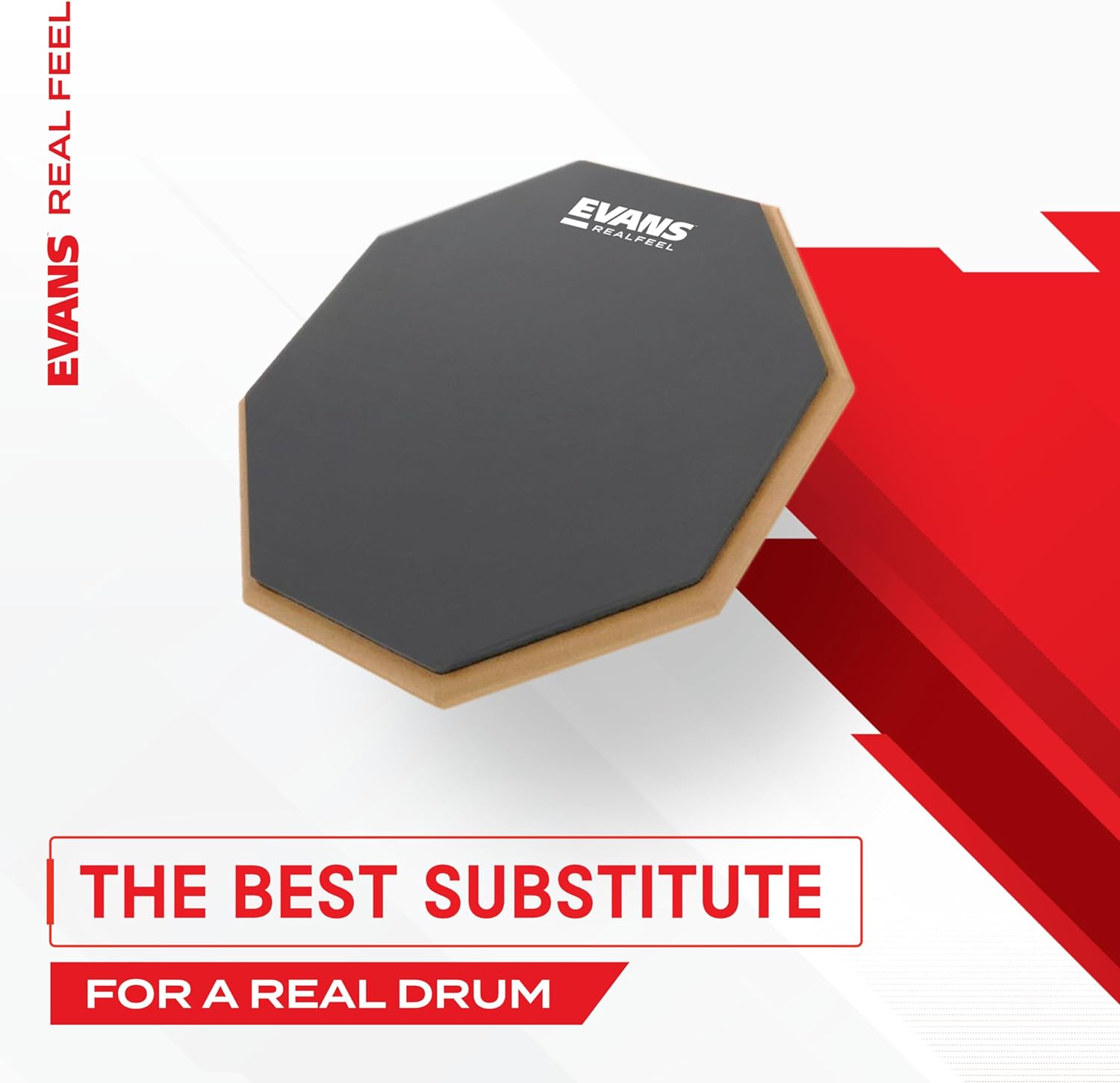
Evans RealFeel is the pad MusicRadar consistently ranks at or near the top of its best practice pads list, and the reason is blunt: it has a dual-sided design — one side is a softer gum compound with pronounced rebound, the other is a harder surface with less give. That’s two training variables in a single $35–$45 purchase. Intermediate players who are building single-stroke roll speed on one side and double-stroke control on the other are getting legitimate value.
Remo’s Ambassador-head pad goes the other direction — an actual coated drumhead stretched over a wooden frame. It replicates snare drum feel more accurately than gum rubber does, because it is a drum head. Owners report it feels and sounds noticeably closer to a real snare, which matters if you’re transitioning between pad practice and live kit work. The tradeoff: it’s louder than gum rubber (not dramatically so, but enough that neighbors notice) and the head will eventually need replacing.
Mesh Pads: Low Volume, High Usefulness
Mesh pads — a woven synthetic surface tensioned over a frame, similar to what electronic kits use — produce almost no acoustic sound and almost no rebound. That last part is the key.
Because mesh pads don’t bounce the stick back at you, every stroke has to be controlled by the player. Experienced players and instructors referenced in Drumhead Magazine’s 2024 buyer’s guide specifically flag mesh pads for developing buzz rolls (a sustained roll technique where the stick bounces rapidly against the surface) and for identifying players who rely too much on surface rebound rather than finger control. If your buzz roll falls apart on mesh, it was already falling apart on gum rubber — you just couldn’t feel it.
The Vic Firth Heavy Hitter series and the Ahead Ahh Pad both use this approach. The Ahead runs denser, closer to foam feel. The Vic Firth mesh is looser and closer to a vintage coated head. Players report meaningfully different muscle fatigue depending on session length; mesh work is genuinely more tiring because your hands are doing more work.
Multi-Zone and Cymbal/Hi-Hat Companion Pads
For players who are building a complete practice setup rather than a single-surface warm-up routine, the market has grown considerably. Pads that include a raised center zone (snare simulation) and a flat outer zone (rimshot simulation) let you practice full kit voicing patterns away from a kit.
The Drumeo P4 Practice Pad — widely covered on Sweetwater’s practice pad guide — took this approach further than most with a 4-zone layout: center head, rim, cross-stick zone, and hi-hat area. Owners report it works best when used alongside a dedicated practice routine (Drumeo’s own curriculum, or one you’ve built). As a standalone investment it’s closer to $80–$100, so the value only materializes if you’re actually doing compositional rudiment work rather than pure speed drills.
By the Numbers
| Pad | Surface Type | Rebound Level | Street Price (2026) | Best For |
|---|---|---|---|---|
| Evans RealFeel (dual-sided) | Gum rubber | Med / High (side-dependent) | ~$35–$45 | All-purpose intermediate work |
| Remo Ambassador Practice Pad | Coated drumhead | Medium | ~$40–$55 | Kit-feel simulation |
| Vic Firth Heavy Hitter Mesh | Mesh | Very Low | ~$30–$45 | Finger control development |
| Drumeo P4 Practice Pad | Multi-zone gum | Medium | ~$80–$100 | Full voicing / pattern practice |
| Pearl Compact Traveler | Gum rubber, foldable | Medium-High | ~$50–$70 | Touring / portability focus |
Street prices sourced from aggregated retailer listings as of mid-2026. Prices vary by retailer.
What Forum Veterans Actually Say (And What Gets Left Out of Reviews)
The gap between press-release coverage and what players say after six months of heavy use is real, and it’s worth naming directly.
On the Remo head pad: Long-run owners note the coated head develops a shiny, worn spot in the center after several months of daily practice, which changes the feel noticeably — the “choke” increases and the rebound tightens. Replacement heads are cheap ($8–$12), but first-time buyers don’t budget for this. It’s not a dealbreaker; it’s a hidden cost worth knowing.
On mesh pads and volume: Mesh pads are dramatically quieter acoustically, but owners in the Drumhead Magazine forums consistently flag what they call “stick-click” noise — the sound of the stick tip making contact without a resonant tone. In a completely silent apartment at midnight, this is still audible. It’s quieter than gum rubber by a significant margin, but not truly silent.
On multi-zone pads: The value proposition for pads like the Drumeo P4 is almost entirely dependent on how structured your practice is. Players who run through random rudiments report the extra zones feel gimmicky. Players running deliberate patterns — specifically working groove construction rather than just chops — report the zones feel genuinely useful. The difference is practice discipline, not pad quality.
Sweetwater’s buying guide makes a point that intermediate players often overlook: pad thickness affects feel as much as surface material does. A thin pad on a hard surface (a wooden desk, a music stand) transmits vibration differently than the same pad on a carpeted floor or padded stand. If your pad feels inconsistent, check what it’s sitting on before assuming the pad is the problem.
The Hidden Costs Nobody Mentions
A $35 practice pad is rarely a $35 purchase in practice:
- Stand or mount: Most pads don’t include a stand. A basic snare stand to hold your pad in proper playing position runs $25–$60. Playing a pad flat on a desk consistently builds bad posture habits. This is the most commonly skipped expense.
- Replacement heads: If you go the Remo drumhead-surface route, factor in one or two head replacements per year at heavy practice volume.
- Sticks: Your practice pad will go through sticks faster than your kit does — the impact dynamics are different and the lack of rebound on mesh pads is particularly punishing on tip longevity. Budget an extra pair per month if you’re logging serious hours.
- Metronome or click track: Not a pad cost, but the single biggest upgrade most intermediate players can make to pad practice quality. A $20 clip metronome or a phone app changes the entire training effect.
The Decision Rule: If X, Then Y
Here’s where everything lands if you’re choosing right now:
If your main goal is speed and rudiment development, and you practice in a medium-noise environment (studio, rehearsal space, daytime house), get the Evans RealFeel dual-sided. The two surfaces give you distinct training modes in one purchase, the price is low enough to buy without agonizing, and the consensus across MusicRadar’s reviews and owner feedback is uniformly strong.
If you practice late at night or in a shared living situation and volume is the constraint, the Vic Firth Heavy Hitter Mesh is the right tool. Accept the lower rebound as a feature, not a limitation — treat every session on it as finger-control focused work.
If you’re actively working on translating pad practice to kit feel — if you’re prepping for a gig, session work, or regular band rehearsal — the Remo Ambassador-head pad is the closest approximation to snare response you can get without an actual snare. The periodic head replacement cost is worth it for the realistic feel.
If you’re doing structured, goal-oriented practice with a curriculum (working through a specific technique program, breaking down groove construction, building a practice routine from scratch), invest in the Drumeo P4 or a comparable multi-zone pad. The additional zones pay dividends in proportion to how deliberately you use them.
If budget is tight and you need one pad that does most things reasonably well, the Evans RealFeel wins that contest without much debate. At $35–$45, it’s the pad that consistently surfaces in forum threads when someone asks “what should I have bought first?” — which is a more useful signal than any press release.
The pads themselves are simple objects. The outcomes they produce are almost entirely downstream of how deliberately you use them. Pick the surface that matches your real constraint — noise, technique goal, or feel — and show up consistently. That’s the whole equation.