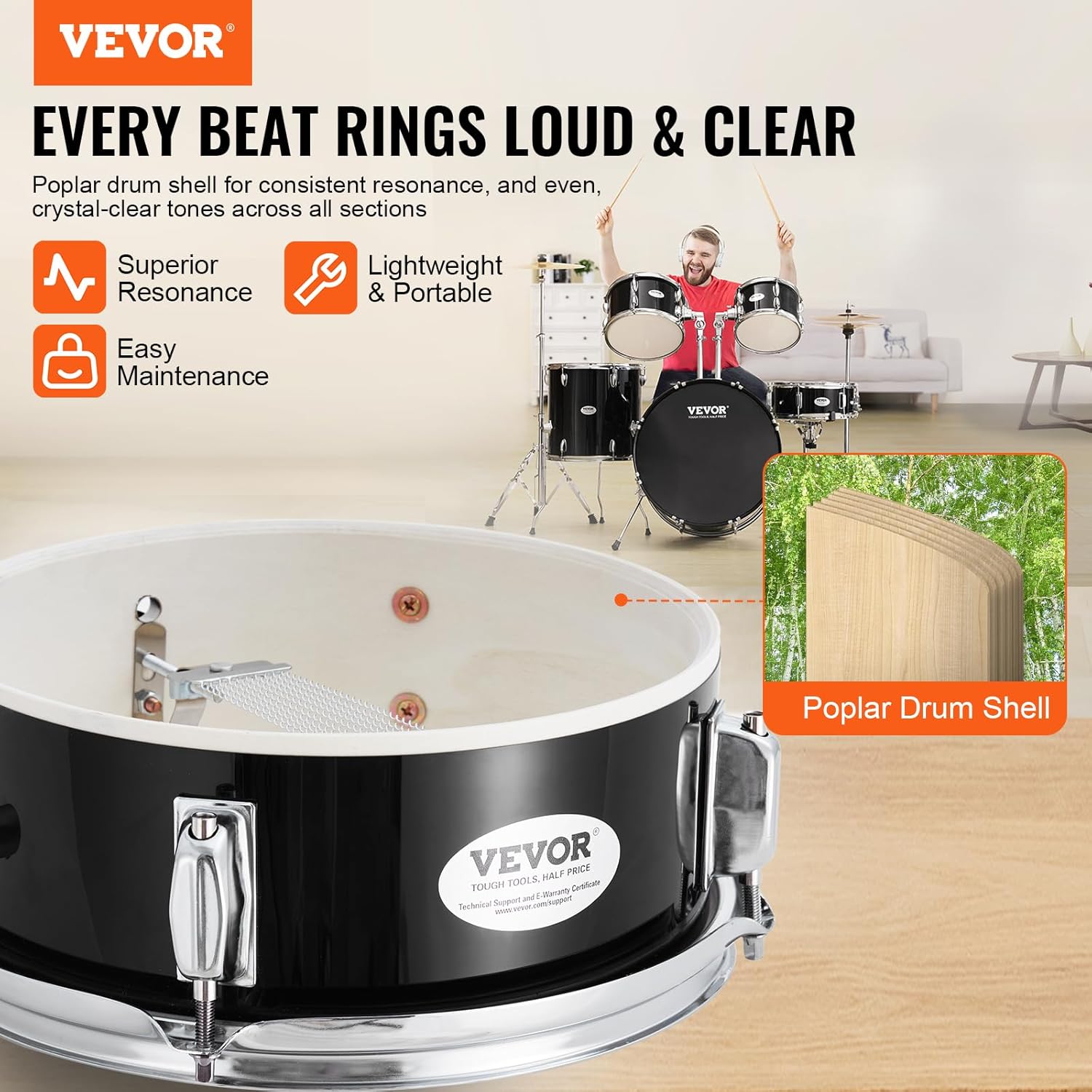
If you’ve been eyeing one of those starter acoustic drum kits — a five-piece shell pack (that’s the set of drums: bass drum, snare, and three tom-toms) listed at $279 or $349 on any major music retailer — you’ve probably felt that small electric jolt of this seems doable. And it is doable. But the sticker price on a beginner acoustic kit is, almost without exception, a floor, not a ceiling. An acoustic drum kit is a system: the shells are only one part of it. Stands, cymbals, a throne (the drummer’s seat), pedals, heads (the drumming surfaces themselves), and sticks all have to show up at the same address before you can make a single sound. Some of those things come in the box. Most don’t. This article walks through exactly what’s included in the major sub-$500 kit categories, what you’ll realistically need to add, and how to frame the full investment before you commit.
What “Five-Piece Kit” Actually Means — and What the Box Usually Contains
The phrase “five-piece” refers to five drums: a bass drum (the big one you kick with a foot pedal), a snare drum (the cracking centerpiece of most beats), and three toms (the melodic accent drums). That’s the shell configuration. It says nothing about cymbals, hardware, or sticks.
Here’s where beginner kits diverge sharply into two categories:
Shell packs include only the drums themselves — no stands, no cymbals, no pedal, no throne. These are more common in the $350–$500 range and are marketed toward players who already own hardware or want to choose their own.
Complete kits (also called “ready-to-play” kits) bundle the drums plus a hardware pack — typically a hi-hat stand (holds the pair of cymbals you open and close with a foot pedal), a snare stand, two or three boom stands for crash and ride cymbals, a bass drum pedal, and a drum throne. Some complete kits in the $250–$450 bracket also include a starter cymbal pack and a pair of sticks.
Per MusicRadar’s best beginner drum kits roundup, the most commonly stocked complete kits in the under-$400 range in 2025–2026 include offerings from Pearl (the Roadshow series), Ludwig (the Accent series), and Mendini by Cecilio. Each of these ships as a genuinely playable setup right out of the box — but “playable” and “performance-ready” are not the same thing.
By the Numbers
| What’s in a typical $299–$449 complete kit | Included? |
|---|---|
| 5 drum shells (bass, snare, 3 toms) | ✅ Yes |
| Bass drum pedal | ✅ Yes |
| Drum throne (seat) | ✅ Yes |
| Hi-hat stand + entry cymbals | Usually ✅ |
| Crash and ride cymbals | Sometimes ✅ (entry-grade) |
| Drumheads (installed) | ✅ Yes — often low-quality |
| Drum sticks | Sometimes ✅ |
| Tom mounts / rack hardware | ✅ Yes |
| Quality drumheads (playable long-term) | ❌ No |
| Drum key (tuning tool) | Sometimes ✅ |
The Hidden Costs: What You’re Almost Certainly Buying Next
This is the section most kit listings quietly skip. Here’s what owners and drummers in long-term forum discussions consistently flag as the first round of necessary spending after unboxing a budget kit.
1. Drumheads: Budget for a Replace Within the First Month
The heads that ship on entry-level kits are functional enough to learn on, but Sweetwater’s drums buying guide explicitly notes that factory-installed heads on starter kits are often a cost-cutting measure — thinner, less responsive, and harder to tune than even mid-grade replacement heads. Replacing the top (batter) heads on a five-piece kit will typically cost $50–$100 depending on brand and style. Remo and Evans both make entry-to-mid-range head sets (like the Remo Ambassador or Evans G1 series) designed exactly for this upgrade scenario.
Don’t sleep on this. Drummers in Drumhead Magazine’s starter kit review roundup consistently report that swapping heads is the single highest-impact improvement on a budget kit — more than any cymbal upgrade.
Estimate: $60–$100
2. Cymbals: The Biggest Budget Surprise
If your kit ships with cymbals, they’re almost certainly stamped brass (sheet metal pressed into shape) rather than cast bronze (the material used in Zildjian, Sabian, Meinl, and Paiste’s professional lines). The difference matters sonically — stamped cymbals have a harsher, trashier tone and less complex sustain — but for learning purposes, they’re workable.
The real issue: the hi-hat stand hardware bundled with budget kits often wears out or wobbles within 6–12 months of regular use. Seasoned owners in multiple forum threads flag hi-hat stands as the first hardware item to upgrade on complete kits.
If you want even modestly better cymbals — something like a Zildjian ZBT or Meinl HCS pack, which represent genuine entry-level cast or multi-cast options — plan for $120–$200 for a three-piece pack (hi-hats, crash, ride). Sound on Sound’s drum recording fundamentals coverage consistently points to cymbals as the most sonically significant variable in a live or recorded drum sound.
Estimate: $0 (if tolerating included) to $200 (entry upgrade)
3. The Bass Drum Pedal: Often the Weakest Link
Budget complete kits include a bass drum pedal, but the mechanisms on sub-$50 pedals — cheap cam designs, lightweight beaters, plastic components — wear unevenly and develop slop (looseness and imprecision in the action) fast. For casual learning this is fine. For building consistent technique, it’s genuinely problematic because you’re training against resistance that changes.
A mid-range single pedal like the Pearl P-930 Demonator or the DW 3000 series runs $80–$130 and represents a credible long-term tool. Drummers who skip this upgrade early often buy it anyway within a year.
Estimate: $0 (if tolerating included) to $130 (mid-grade upgrade)
4. A Drum Key: Small but Mandatory
A drum key is the small T-shaped wrench used to tune drum lugs (the tension rods around the head). Without one, you cannot tune your kit — and untuned drums sound terrible regardless of how good the shells are. Many complete kits include one; shell packs almost never do.
Estimate: $3–$8
5. Sticks: You’ll Go Through Them
Many kits include one pair. Sticks break, chip, and wear — and a single pair won’t last through a month of regular practice. A 12-pack of Vic Firth 5A or ProMark TX5AW runs $25–$35 and is a smarter buy than singles.
Estimate: $25–$35 (for a multi-pack)
6. Practice Pad or Mesh Head: Optional but Smart
If you’re in an apartment or have noise-sensitive neighbors, an acoustic kit — even a budget one — is genuinely loud. Mesh drum heads (replacement heads made of woven mesh that dramatically reduce volume) can be swapped onto existing shells for $30–$60 per head. Alternatively, a dedicated practice pad like the Remo 12” Practice Pad ($35–$45) lets you work on technique without setting up the full kit.
Estimate: $35–$200 depending on approach
The Real Budget Math: Starter Kit Total Cost of Ownership
Let’s put it together for two realistic scenarios.
Scenario A: Buy a $349 complete kit, tolerate what’s included, add essentials only
- Kit: $349
- Drum key: $5
- Extra sticks (12-pack): $30
- Total: ~$384
This is the minimum viable setup. It’s genuinely playable. The heads, cymbals, and pedal will eventually frustrate you, but you’ll have months of productive learning time before that happens.
Scenario B: Buy a $349 complete kit, upgrade the high-impact items in month one
- Kit: $349
- Replacement batter heads (Remo Ambassador set): $80
- Entry cymbal pack upgrade (Meinl HCS or Zildjian ZBT): $150
- Mid-grade bass drum pedal (DW 3000 or Pearl P-930): $110
- Drum key: $5
- Extra sticks: $30
- Total: ~$724
That’s a meaningfully better setup — one that owners in long-run gear discussions consistently describe as capable of carrying you through 2–3 years of learning without feeling like the gear is holding you back.
Per Sweetwater’s drums buying guide, this $700–$800 “real cost” framing for beginner acoustic kits aligns with what their sales advisors communicate to new drummers who ask about the full investment picture.
Which Brands Are Worth Considering in This Price Range?
Based on aggregated owner reviews and editorial roundups from MusicRadar and Drumhead Magazine, three brands consistently surface as the most credible options under $500:
Pearl Roadshow Complete ($349–$449 depending on configuration): Pearl is a major global manufacturer with decades of production experience. The Roadshow line ships with Remo heads (a real brand with a real reputation), which is unusual at this price point and meaningfully reduces the urgency of a head upgrade. The included hardware is functional if not robust. Owners report this kit holds its tuning better than most in the category.
Ludwig Accent ($299–$399): Ludwig is a historic American brand — the company that built John Bonham’s and Ringo Starr’s kits in the 1960s. The Accent is their entry-level line, and while the shells are basic poplar wood, the Ludwig name carries genuine resale value relative to off-brand alternatives. MusicRadar consistently places this kit among their top beginner recommendations.
Mendini by Cecilio ($249–$299): The most affordable complete kit with reasonable build quality. Owners report it’s appropriate for children or absolute beginners in low-stakes settings, but the hardware weaknesses show up faster under regular adult use. Consider this the true floor of the category.
The Decision Rule: If X, Then Y
If your budget is genuinely capped at $350 or under and you need to start now: the Pearl Roadshow or Ludwig Accent at their sale prices are credible entry points. Buy the drum key, buy extra sticks, and plan to replace batter heads within 60 days. That’s the honest minimum.
If you can stretch to $650–$800 total: spend $349–$399 on the kit and allocate the remainder to the three high-impact upgrades — heads, cymbals, pedal — in that priority order. This is where the investment starts to feel like a real instrument rather than a learning prop.
If you’re buying for a child under 12: consider a junior kit (smaller shell sizes like 16” bass drum) from Pearl or Ludwig in the $199–$299 range, and skip the upgrades entirely until they’ve demonstrated 6+ months of sustained interest.
If you’re an intermediate player coming back to acoustic drums from electronic or looking to practice at home: skip the complete kits and spend your $500 on a quality used shell pack from a brand like Gretsch, Yamaha, or Pearl Export — then source used hardware separately. The depreciation math strongly favors used mid-grade over new entry-grade in this scenario. Gear depreciation tracking across gear sales communities consistently shows Pearl Export and Yamaha Stage Custom shells retaining 50–70% of their value over 3–5 years; entry-level complete kits often retain 20–30%.
The box contains a starting point. The question is always: starting point toward what, and over what timeline? Answer that honestly and the budget math writes itself.